
Culture isn't a poster: the five things that actually build it
Every company I've ever walked into has a culture. There’s always some kind of statement about it. Sometimes it’s a laminated poster in the break room. Maybe it’s embedded in the onboarding deck. Painted, in some cases, directly on the wall — "Integrity. Excellence. Teamwork." — in a font someone in marketing chose with real care.
And in almost every one of those companies, the actual culture is being decided somewhere else entirely: in the meeting after the meeting or by the behavior that is allowed to go on.
You know what I’m talking about. The real meeting happens, everyone nods, the decision seems settled — and then three people linger in the hallway or hop on a separate call to say what they actually think. That second conversation is where the truth lives. And whatever gets said there, not on the wall, is your culture.
Culture isn't a poster. It's the question you allow at the table — and the one you don't. It’s also about the behaviors that you promote and talk about - and the ones you allow.
Why culture statements rarely become culture
A values statement describes an aspiration. Culture is what a team does under pressure when nobody's watching and the stakes are real. It’s the actions and behaviors of the humans that make up the organization.
The gap between those two things is where most leaders get stuck. They treat culture as a communications problem — write it well enough, repeat it often enough, and it will take hold. But culture isn't built through declaration. It's built through repetition of behavior, especially the behavior a leader models when something goes wrong.
If your values statement says "transparency" but the last person who raised a hard truth in a meeting (speaking straight) got quietly sidelined, your team doesn't believe the poster in the break room. They believe what happened to that person. Teams are always watching for the gap between what's said and what's rewarded, and they calibrate their own behavior to the gap, not the statement.
This is why I tell clients that a culture initiative is rarely a communications project. It's a leadership behavior project, and it starts at the top.
The five behaviors that actually create high-performance culture
Across years of working inside leadership teams — through the xchange Approach and development conversations — I keep seeing the same five behaviors separate the teams that perform at a high level from the teams that merely look good on paper.
- Speaking Straight. High-performing teams have a habit of saying the thing everyone is thinking but nobody wants to say first. They lean into the discomfort of calling out the thing that’s not helping the team move forward. That habit has to be modeled by the leader before anyone else will risk it.
- Be willing to Ask Questions. The meeting after the meeting is the clearest symptom of a culture problem. High-performing teams build norms that make it safer to disagree openly than to disagree quietly and comply publicly.
- Practice Extreme Ownership. Watch how a team talks about a miss. Weak cultures produce explanations. Strong cultures produce ownership — a clear "that was mine to catch" instead of a paragraph of context. Owning problems and mistakes is the fastest way to a high-performing team.
- Honoring Commitments. Culture is built more by the follow-through on minor promises than by grand gestures. A leader who consistently does the small thing they said they'd do earns the credibility that makes the big asks possible later.
- Practicing the Human Touch. Teams that perform under pressure tend to know each other beyond the org chart. That knowledge isn't a soft nicety — it's the trust reserve a team draws on when things get hard.
None of these five behaviors require a poster. They require a leader willing to go first, consistently, until the behavior becomes the norm rather than the exception.
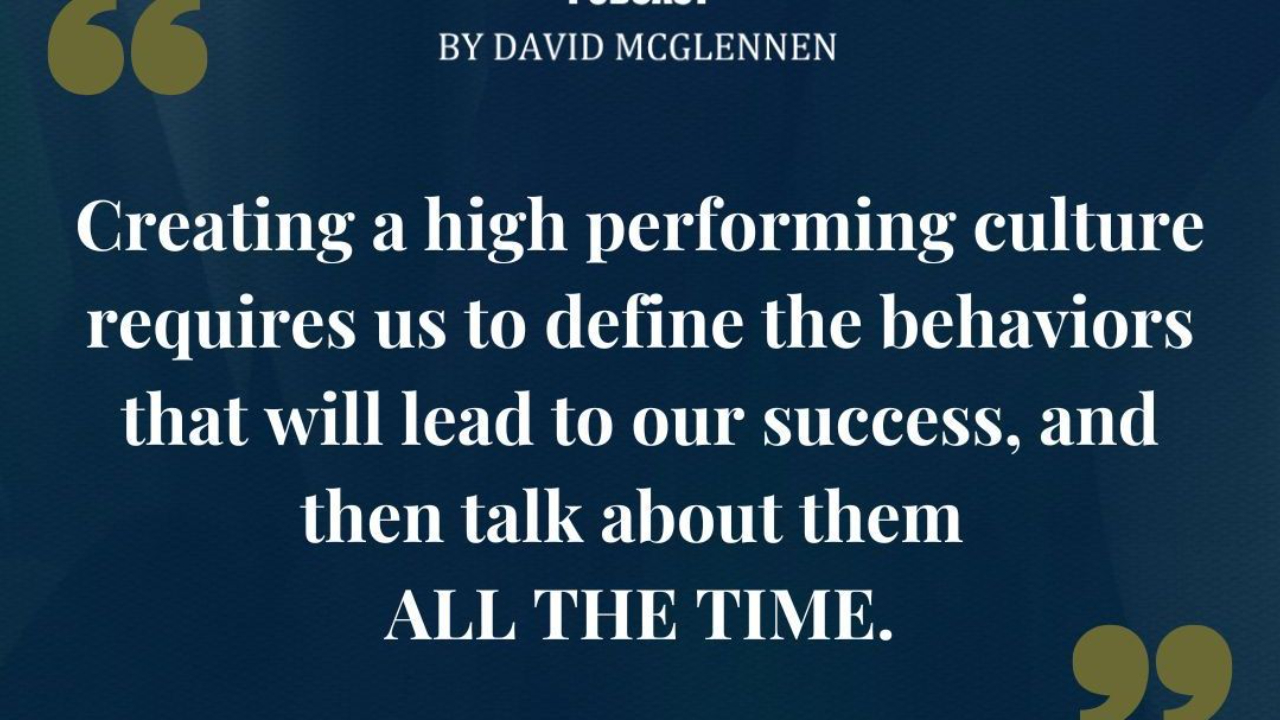
Practice them. Create rituals around them. Talk about them every chance you have.
The three silent culture killers
If those five behaviors build culture, three quiet patterns are what erode it — and they're rarely dramatic. They're slow, and that's what makes them dangerous.
Avoidance. The hard conversation that keeps getting pushed to next week. The underperformance that goes unaddressed because confronting it feels harder than tolerating it. Avoidance doesn't announce itself. It just accumulates, one deferred conversation at a time, until the team has quietly recalibrated its standard for what's acceptable.
Drift. The slow separation between what a team says it values and what it actually rewards. Drift happens gradually enough that no single moment feels like a violation. Then one day a leader looks up and realizes the team has drifted a long way from where it started, without a single dramatic event to point to.
Performance theater. The version of culture that shows up for the all-hands meeting and disappears the moment the cameras — literal or figurative — turn off. Performance theater is often mistaken for culture because it's visible. But visible and real are not the same thing, and teams can tell the difference even when leadership can't.
Each of these killers has the same antidote: a leader who's willing to name what's actually happening instead of what's comfortable to say.
What Bob Chapman's people-first model gets right
In Everybody Matters, Bob Chapman makes a case that reframes the entire conversation: the measure of a leader isn't the performance of the company, it's what happens to the people because of the way the company is led.
That ordering matters. Chapman's argument isn't that culture is a nice-to-have alongside performance — it's that genuine care for people is the mechanism that produces performance, not a competing priority to be balanced against it.
What Chapman gets right, and what I see confirmed in every high-performing team I've worked with, is that people don't perform at their best because they're managed well. They perform at their best because they're led by someone who has demonstrated, repeatedly and specifically, that their wellbeing matters beyond their output.
That's not a soft idea. It's a rigorous one. It requires a leader to hold both the standard and the person at the same time — refusing to lower the bar out of false kindness, while refusing to treat the person as replaceable in pursuit of the bar.
How fractional leadership accelerates culture work
One of the reasons fractional leadership engagements move faster on culture than internal efforts often do is structural, not magical.
A fractional leader — an Integrator, a coach, an outside operator embedded part-time — has permission an internal leader sometimes doesn't. They can name the meeting-after-the-meeting pattern without it reading as a political move. They can ask the question the team has been avoiding, because they don't carry the history that makes the question feel loaded.
That outside vantage point doesn't replace the leader's role in modeling the five behaviors above — it accelerates the team's willingness to adopt them. A fractional leader can diagnose the drift, name the avoidance, and hold up a mirror in the first thirty days that might otherwise take a team a year to hold up for itself.
Culture work moves at the speed of trust. An outside leader, brought in with the right mandate, can compress the time it takes to build that trust — not because they're smarter, but because they're not carrying the same baggage the team is carrying with each other.
The question worth sitting with
The next time your team leaves a meeting, pay attention to what happens in the next ten minutes. Does the real conversation happen in the room, or does it happen after — in the hallway, in a side channel, in a call you weren't on?
That answer will tell you more about your culture than any statement on your wall ever could.
FAQ
What is high performance culture? High performance culture is the set of behaviors a team consistently practices under pressure — not the values it states in writing. It shows up in how issues get named, how disagreement is handled, and how outcomes are owned, especially when things go wrong.
How do you build a high-performance team culture? You build it through leadership behavior, not communication campaigns. Leaders who consistently name real issues, invite disagreement in the room, own outcomes without hedging, follow through on small commitments, and treat people as whole people create the conditions for high performance to take root.
What kills company culture? The three most common and quietest culture killers are avoidance (deferring hard conversations), drift (a slow gap between stated values and rewarded behavior), and performance theater (visible displays of culture that don't hold up under real pressure).
David McGlennen is the founder of Impact Leadership Consulting, working as an executive coach and fractional Integrator for founders and leadership teams navigating growth, succession, and culture. Learn more at davidmcglennen.com.

Stay connected with me and receive my updates!
Recent Posts
